A Damascus chef knife is one of those purchases that feels significant — and it should. You’re not just buying a kitchen tool. You’re investing in something that, if chosen well, will outlast dozens of cheaper alternatives and make every prep session noticeably better.
The problem? Most guides online hand you a list of products and call it done. That’s not enough when you’re spending $100 to $500+ on a single blade. You need to understand what separates a genuinely great Damascus chef knife from a pretty one with weak performance.
This guide gives you that knowledge. By the end, you’ll know:
- What modern Damascus steel actually is (and what it isn’t)
- Which blade features matter most for a chef knife
- How much to spend and what you get at each price point
- The top Damascus knife brands worth considering in the USA
- How to maintain your knife so it stays sharp for years
What Is Damascus Steel — Really?
Let’s clear this up early, because there’s a lot of confusion around it.
True historical Damascus steel — the legendary wootz steel from the Middle East — no longer exists in its original form. The technique was lost centuries ago. What we call “Damascus steel” today is more accurately called pattern-welded steel.
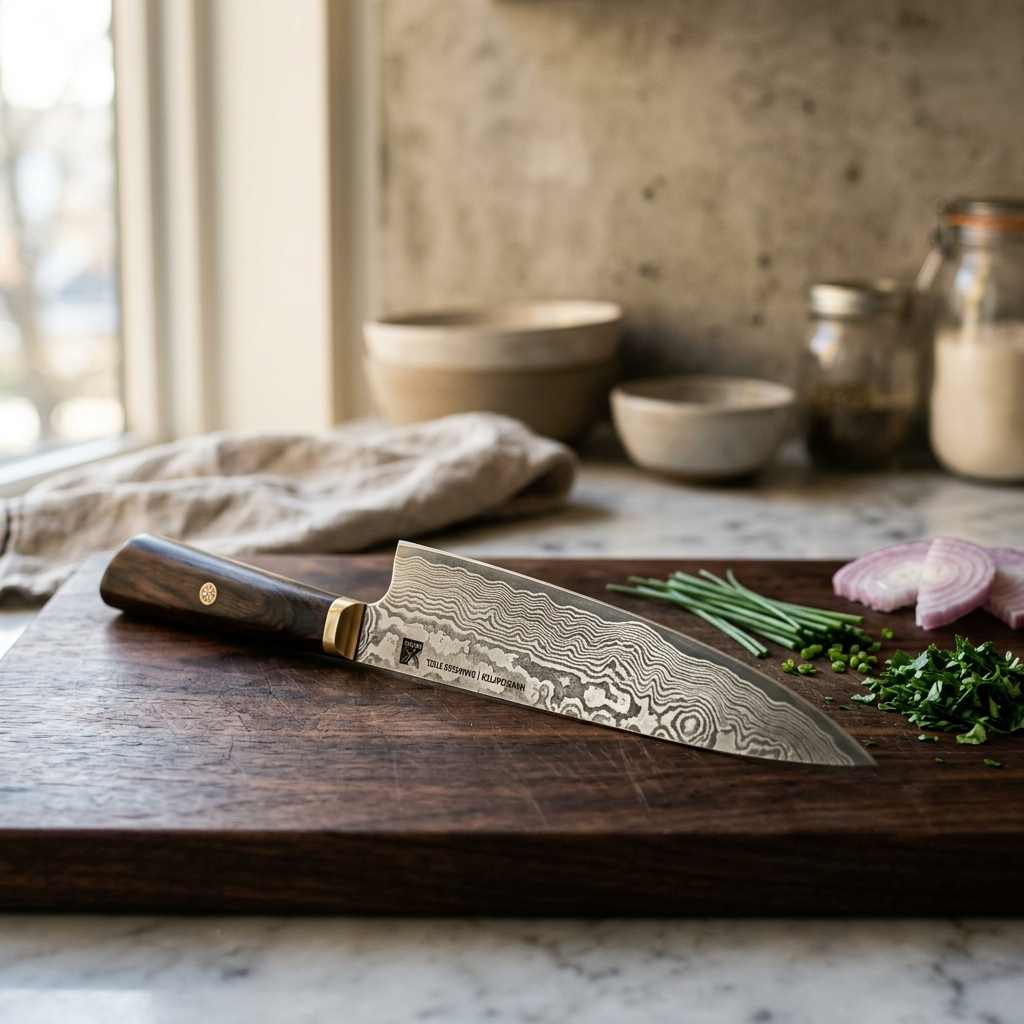
Modern Damascus knives are made by forge-welding multiple layers of different steel alloys together, then folding, twisting, and drawing them out under heat and hammer. The result is that beautiful flowing pattern of light and dark waves on the blade. The more folds, the more layers, and the more intricate the pattern.
Here’s what that means for performance: the patterning itself isn’t what makes a Damascus knife sharp or durable. It’s the quality of the core steel that does the heavy lifting. The cladding layers around that core are often stainless steel, which protects the knife from corrosion. The inner core — often high-carbon steel — is what holds and takes an edge.
So when you’re evaluating any Damascus chef knife, look past the pattern and ask: what steel is at the center?
What to Look for in the Best Damascus Chef Knife
Blade Steel and Layer Count
Layer count gets marketed heavily — you’ll see 33-layer, 67-layer, even 200-layer Damascus blades. More layers don’t automatically mean better performance. What matters more is the quality of the steels being layered and the skill of the smith.
Common core steels to look for:
- VG-10 – A Japanese stainless steel that holds a sharp edge well, resists corrosion, and is easy to maintain. One of the most popular Damascus core steels on the market.
- AUS-10 – Similar to VG-10, slightly more affordable, still solid performance.
- SG2 / R2 (Super Gold Powder Steel) – Higher hardness (Rockwell 63+), holds an edge exceptionally well, found in premium knives.
- High-carbon steel (1075, 1095) – Excellent edge retention and sharpness, but requires more maintenance to prevent rust.
For the best Japanese Damascus chef knife options, look for VG-10 or SG2 cores — they’re the sweet spot of performance and durability.
Edge Geometry and Bevel
Edge geometry determines how a knife actually cuts. Two things to evaluate:
- Bevel angle – Japanese-style knives typically run 15–16 degrees per side, which gives a finer, more precise edge. German-style knives run closer to 20 degrees — slightly less sharp but more durable for heavy tasks.
- Blade profile – A curved belly on the blade suits rock-chopping. A flatter profile works better for push-cutting vegetables. Most chef knives blend both.
For kitchen use, a slightly thinner Japanese-style bevel typically performs better for slicing, dicing, and fine cuts.
Handle Comfort and Material
A chef knife you’ll use daily needs to feel right in your hand — not just look good. Common handle materials on Damascus knives include:
- Pakkawood – Layered wood resin composite. Durable, moisture-resistant, attractive.
- G10 (fiberglass composite) – Extremely durable, no moisture absorption, often used on tactical and premium kitchen knives.
- Micarta – Similar to G10, with a slightly warmer, more traditional feel.
- Natural wood – Beautiful but requires more care; can crack or warp if exposed to moisture repeatedly.
- Resin/stabilized wood – Wood infused with resin for better durability and unique aesthetics.
Handle shape matters too. A bolster-free design is often preferred by professional cooks because it allows a proper pinch grip all the way up to the blade.
Full Tang Construction
This is non-negotiable for a serious chef knife. Full tang means the steel of the blade runs the entire length of the handle — you can often see it on the handle’s spine edge. It creates better balance, more durability, and reduces the risk of the blade separating from the handle over time.
Avoid half-tang or rat-tail tang construction on a primary kitchen knife. It’s a shortcut that shows up in lower-quality blades.
Balance and Weight
There’s no universally “correct” balance point — it comes down to how you cut. Most chef knives balance near the bolster, between the blade and handle. Heavier knives work well for breaking down tougher ingredients. Lighter knives give you more control and speed for fine work.
If you can, hold the knife before buying. If not, read detailed weight specs. A typical 8-inch chef knife should fall between 6–9 oz.
Also Read: Best Bowie Knife: Top 10 Picks for Hunting & Self-Defense
Damascus Knife Price in the USA: What Each Budget Gets You
Price is one of the most searched aspects of Damascus knives — and for good reason. Here’s a practical breakdown of Damascus knife prices in the USA:
Under $80 — Entry-Level Damascus
At this price, you’re mostly paying for the look. The Damascus pattern may be genuine, but the core steel is often lower-grade. Edge retention and fit-and-finish will be noticeably inferior. Good for casual cooks curious about Damascus aesthetics.
$80–$200 — Mid-Range (Best Value Zone)
This is where serious buyers get the most for their money. Blades in this range typically feature VG-10 or AUS-10 cores, better fit and finish, and genuine full-tang construction. Many well-regarded Japanese Damascus chef knives live in this range.
$200–$400 — Premium Performance
Here, you’ll find SG2 or higher-grade core steels, more intricate Damascus patterning, refined handle materials, and better overall craftsmanship. Brands like Shun, Miyabi, and Zwilling operate heavily in this space.
$400+ — Professional and Artisan-Grade
At this tier, you’re often looking at handmade or semi-handmade knives from specialist smiths. Every detail — steel selection, heat treatment, grind, handle fitting — is done with precision. These knives can last a lifetime with proper care.
Top Damascus Knife Brands Worth Knowing
When people search for the best Damascus knife brand, a few names consistently earn their reputation:
- Shun (Japan) – One of the most recognized Japanese Damascus chef knife makers. Their Classic line uses VG-MAX steel with a 68-layer Damascus cladding. Refined aesthetics, solid performance.
- Miyabi (Japan/Germany) – A collaboration between Japanese craftsmen and Zwilling. Known for high-hardness steels and beautiful finish work.
- Zwilling (Germany) – Primarily German in engineering, but their Kanren and other lines incorporate Japanese-style Damascus techniques effectively.
- Yoshihiro (Japan) – Strong performer at mid-range prices, popular with serious home cooks.
- Cangshan (USA-based, international manufacturing) – Offers genuinely good value in the mid-range, with clean design and accessible pricing.
If you want the best Damascus chef knife in the USA for value and performance, Shun and Yoshihiro tend to come out on top across most independent reviews. For pure performance at a premium, Miyabi’s SG2-core knives are hard to beat.
Handmade Blades: A Different Standard of Craftsmanship
There’s a meaningful difference between factory-produced Damascus knives — even excellent ones — and knives made by hand in a forge.
Handmade blades are shaped, ground, and heat-treated by a smith who controls every variable. The result can be more personal, more precise, and often more durable than what an automated production line delivers. This is true for kitchen knives, but it’s especially evident in field and survival blades where the steel faces real stress.
If you appreciate handcrafted edge tools, it’s worth exploring beyond the kitchen. Our hand-forged Bowie knives are built with the same commitment to material quality and construction integrity — full tang, quality steel, real-world durability. They’re a natural next step if handmade blades interest you beyond the cutting board.
How to Maintain Your Damascus Chef Knife
A great Damascus knife poorly maintained will underperform a cheap knife cared for well. Here’s what to do:
Everyday Care
- Hand wash only. Dishwashers destroy edges and can corrode Damascus cladding. Always wash by hand with mild soap and dry immediately.
- Dry thoroughly. Don’t leave Damascus knives air-drying or submerged in water, especially if the core steel is carbon-based.
- Use a proper cutting surface. Wood or plastic boards only. Glass, ceramic, and stone boards dull edges fast.
Honing and Sharpening
- Hone regularly with a ceramic honing rod or leather strop to realign the edge between sharpenings.
- Sharpen on whetstones when honing no longer restores performance. For Japanese-style knives, use a 1000-grit stone for sharpening and 3000–6000 grit for finishing.
- Avoid electric pull-through sharpeners on Damascus knives — they remove too much material and can damage the pattern.
Storage
- Store on a magnetic knife strip or in a knife block. Drawer storage without guards causes edge damage and is a safety hazard.
FAQ: Your Damascus Chef Knife Questions Answered
What is the best Damascus chef knife?
There’s no single answer — it depends on your budget and cutting style. For most home cooks, a VG-10 core Damascus knife from Shun or Yoshihiro in the $100–$200 range delivers outstanding performance. If you want to step up, Miyabi’s SG2-core knives offer elite edge retention for serious cooks willing to spend $250–$400.
Are Damascus chef knives worth it?
Yes, if you’re buying one with a quality core steel and proper construction. The Damascus pattern itself doesn’t make a knife sharper, but the premium materials and craftsmanship that typically accompany genuine Damascus knives do translate to real-world performance. Budget Damascus knives that are all aesthetics and no substance are not worth it.
What are the top 5 chef knife brands?
For Damascus-specific options, the most respected brands are Shun, Miyabi, Zwilling, Yoshihiro, and Cangshan. Broader chef knife rankings often include Wüsthof and Global as well, though those brands focus less on Damascus steel specifically.
How much is a real Damascus chef knife?
A genuine Damascus chef knife — one with real pattern-welded steel and quality construction — starts at around $80 and runs to $500 or more for artisan pieces. Anything branded as “Damascus” under $50 is almost certainly acid-etched stainless steel with a fake pattern, not true pattern-welded Damascus.
How much should a good Damascus knife cost?
For a reliable daily-use Damascus chef knife, budget $120–$250. That range reliably gets you VG-10 or AUS-10 core steel, full tang construction, a quality handle, and a factory edge sharp enough to satisfy most cooks. Going higher gets you marginal but real improvements in steel hardness, edge retention, and craftsmanship refinement.
What knife does Gordon Ramsay use?
Gordon Ramsay has publicly used and recommended knives from Wüsthof and Henckels (Zwilling) — both German brands known for durability and balance. He’s not specifically a Damascus knife advocate, but he emphasizes quality steel and proper technique over brand loyalty. His preference for German-style knives reflects a prioritization of durability and versatility over the thinner Japanese bevel.
Conclusion: Buy Smart, Buy Once
The best Damascus chef knife for you is the one that matches your actual cutting habits, fits your hand comfortably, and is built with steel you can rely on. Don’t buy a Damascus knife for the pattern — buy it for the craftsmanship behind it.
Start with your budget. If you’re in the $120–$200 range, prioritize a VG-10 core, full tang construction, and a handle that feels balanced in your grip. If you’re ready to invest more, SG2 core knives from Miyabi or comparable makers will reward you with edge retention that’s genuinely exceptional.
Take care of what you buy — hand wash, dry, hone regularly, sharpen on a whetstone — and a quality Damascus chef knife will be one of the best kitchen decisions you ever make.
Ready to explore more handcrafted blades? Browse our full knife collection and find the right tool for every task.